The Lighter Side of Boas, T- Albinos
In contrast to incomplete dominant morphs of boas, we now turn to the lightest boas we breed in South Africa—the most extreme forms of Kahl Albino.
For many years, “Albino Boas” simply referred to the T- (Tyrosinase-negative) Albino, known as the Kahl Albino. These were the original albino boas, first bred by Pete Kahl in 1993. The gene originated from a group of four baby boas found in Colombia. However, breeding them proved difficult, and the original owners eventually sold a single male to Pete Kahl for $25,000—an amount that could have been a house deposit at the time. He later paired this male with a het female, successfully establishing the gene. By power-feeding the females, he managed to breed them after just a year, producing three visual albino babies, and the rest is history.
Understanding T- Albinos
T- Albinos cannot produce black pigment, resulting in white snakes with red or yellow patterns and red eyes—similar to albino mice. This is a recessive gene, meaning both parents must carry it to produce albino offspring. When an albino is bred to a wild-type boa, all babies will appear normal but carry the gene for albinism. Breeding two hets together has a 25% chance of producing visual albino offspring.
Since recessive traits are not visibly expressed in hets, identifying them is nearly impossible without genetic testing. In some cases, experienced breeders may make an educated guess when looking at a full clutch. When purchasing a het baby from a breeder, always ask for photos of the parents to confirm genetics.
Selective Breeding in Kahl Albinos
There are a few lines of Kahl Albino, selectively bred to enhance specific traits:
-
Lipstick Albino: These boas are pure white with vivid red markings, resembling lipstick on white paper. This is a polygenic trait, meaning it is refined through selective breeding by pairing the reddest individuals. However, even when both parents are Lipstick Albinos, some offspring may not display the extreme coloration. In many cases, the most intense Lipstick coloration may take a generation or two to appear.
-
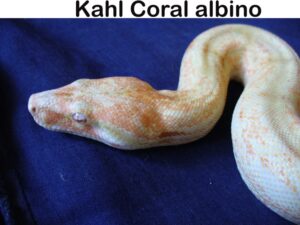
Coral Albino: This trait enhances red and orange pigmentation, particularly on the tail and head. Coral Albinos also develop speckling between their saddles. However, not all offspring from Coral Albino parents will express the trait. It often takes over a year for the coloration to fully develop, which is why they are typically sold as “Coral Line” boas, meaning there is a chance they will develop the trait over time. Pete Kahl began line-breeding Coral Albinos in the early days of albino boa breeding, taking nearly a decade to refine the trait for consistent results.
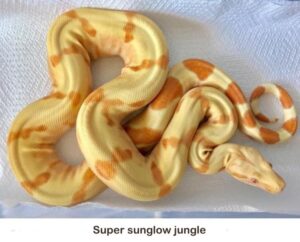
Both of these albino variations produce stunning Sunglows (Hypo Albino), and the Motley Albino is also highly striking. The Sunglows can be combined with Jungle to create Jungle Sunglows, which are exceptionally beautiful. Many different morphs have been developed using Kahl Albinos.
Blood boas
Even though Blood does not fall on the light side of boas the best combinations usually have T- albino in it.
Blood boas originate from El Salvador. Ron St Pierre found them in a bag of new imports along with a hypo and aneries (type two). He raised them and proven out the gene and even crossed the two genes (Blood and Anery) with each other. This is why Aneries still pop up from time to time.
Hypo Bloods are very sought after as are Jungle Bloods which also brings out the red.
When Kahl albinos are crossed with Blood Boas, they produce Red Dragons and with hypo added they make Sun Dragons.
When Sharp Albino are crossed with Blood they are called Bloody Sharps and when Hypo is added to this combination they are called Fire Opal boas (but not the same as Fire boas.)
Snow and Moonglow Boas
When Anery (which eliminates red pigment) is combined with Albino (which eliminates black pigment), the result is a mostly white boa known as a Snow Boa. However, as they age, many Snow Boas develop yellow coloration.
A Moonglow Boa is created by adding Hypo to the Snow Boa genetics. Moonglows retain some pattern but have white eyes with red pupils. Producing these morphs requires precise genetic pairing, as two recessive genes (Albino and Anery) and one incomplete dominant gene (Hypo) must all be present. Typically, this is achieved by breeding a Ghost Boa (Hypo + Anery) to an Albino het Anery or pairing a Sunglow (Albino + Hypo) to an Anery het Albino.
The Sharp Albino Strain
The other T- Albino commonly found in South Africa is the Sharp Albino, which is genetically distinct from Kahl Albinos. In 1991, Brian Sharp imported a wild-caught female Albino Boa from Colombia. He produced 100% het offspring and established the strain by breeding them back to the mother and among siblings.
Sharp Albinos are whiter than Kahl Albinos and retain their colour better as they age. However, Kahl and Sharp Albinos are not compatible, meaning breeding them together results in double-het offspring rather than visual albinos. Unfortunately, during early breeding projects, some snakes were mislabelled and sold as Sharp Albinos when they were actually mixed-line boas. Even Brian Sharp initially bred his female to a Kahl Albino before realizing they were incompatible, requiring him to purify the bloodline before officially naming it after himself.
Sharp Albinos produce breath-taking Sharp Sunglows, and when combined with Surinam Boas, they result in particularly impressive offspring. At one point, we imported some from Prehistoric Pets and successfully bred them twice. Unfortunately, during South Africa’s load-shedding crisis, we lost both the offspring and the parents, as they are highly sensitive to prolonged periods without heat.
Paradigm and Paradise Boas
Strangely, when Sharp Albino (T-) is combined with Boa Woman Caramel Albino (BWC, a T+ Albino), the resulting offspring are Paradigm Boas—visually distinct snakes that are lighter than BWC Albinos but not fully white like Sharp Albinos. These boas are effectively double-hets, capable of producing either Sharp Albinos or BWC Albinos in future breeding.
Similarly, crossing Sharp Albino with Prodigy (another T+ Albino) produces a Paradise Boa. Some argue that Prodigy and Boa Woman Caramel are the same gene, but side-by-side comparisons—especially of their Sunglow versions—show clear differences in colour intensity.
Health Considerations
Both Kahl and Sharp Albinos occasionally suffer from eye issues at birth, a problem that has been reduced through selective breeding but still occurs. Many breeders prefer not to discuss this issue openly.